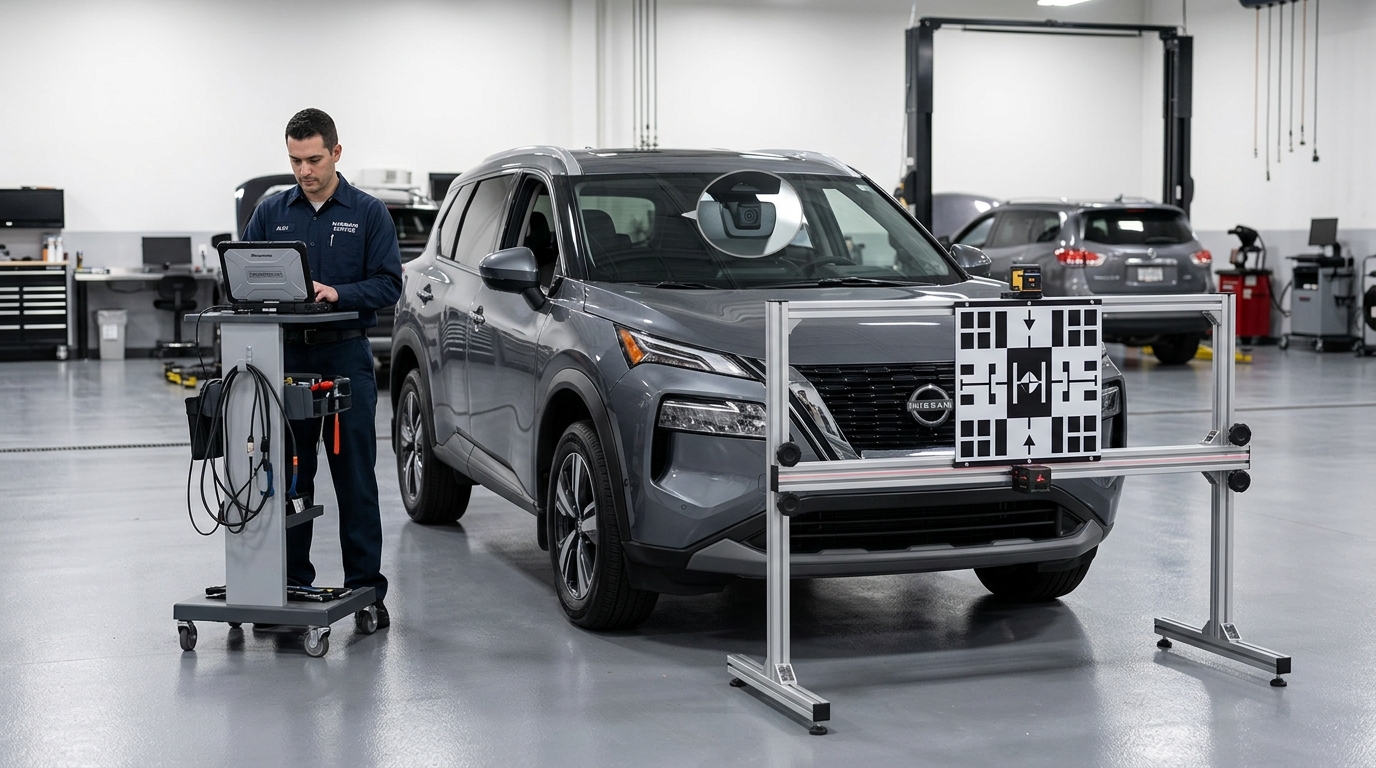
Maintaining vehicle advanced driver assistance systems (ADAS) for long-term reliability requires keeping windshields and bumper fascia clean, scheduling digital sensor target recalibration after wheel alignments or windshield replacements, verifying clear camera optics, and repairing front-end body or suspension damage promptly using genuine OEM parts.
Modern driver-assist technology relies on a complex network of radar emitters, ultrasonic sensors, and optical cameras working together in real time. In northern suburban environments like Niles, harsh winter driving conditions pose ongoing challenges to sensor optics. Accumulations of road salt, slush, mud, and ice over the front grille or upper windshield directly block the sightlines of forward radar units and camera modules. Regularly clearing these surface obstructions with soft microfibers prevents false warnings or sudden system disengagements.
Beyond simple exterior cleaning, physical changes to your vehicle's structure alter sensor alignment geometry. Installing a replacement windshield, adjusting wheel alignment angles, or repairing minor front bumper impacts physically shifts camera mounting angles and radar trajectories. Even a misalignment fraction of a single degree can cause forward monitoring systems to miscalculate vehicle distances at highway speeds.
When collision repairs or suspension work occur, certified technicians perform static and dynamic calibrations. Static calibration uses precision optical target boards and laser alignment frames in a controlled service bay, while dynamic calibration involves specialized road testing under controlled conditions to verify radar tracking. For questions regarding sensor maintenance or to schedule an inspection, contact our team directly at (224) 537-0287 or visit our Niles service location.
Table of Contents
- What Active and Essential ADAS Features Provide the Best Safety Value?
- What ADAS Levels Should You Look for and How Do Level 2 Systems Work?
- Why Is Automatic Emergency Braking a Must-Have and How Is It Regulated?
- Should You Rely on Both Crash Tests and ADAS Calibration for Total Safety?
- How Should You Test Drive and Setup ADAS Features Around Niles, IL?
- Common Questions About ADAS Calibration and Maintenance
- How Does Professional Maintenance Keep Nissan Safety Shield 360 Operational?
What Active and Essential ADAS Features Provide the Best Safety Value?
Active safety features like automatic emergency braking with pedestrian detection, blind-spot warning, and rear cross-traffic alert offer the highest safety value because they actively intervene to prevent collisions before an impact occurs.
Automotive safety components divide into two distinct categories: active safety systems and passive safety systems. Passive safety features, including airbags, seatbelt pre-tensioners, crumple zones, and reinforced cabin frames, function solely during a collision to mitigate physical injury to occupants. Active safety features, on the other hand, continuously monitor surroundings through radar and optical sensors to prevent impacts entirely.
Essential active systems provide multi-directional protection across daily commuting scenarios:
- Automatic emergency braking: Scans the road ahead for stopped vehicles or pedestrians, providing audible alerts and applying full hydraulic braking if the driver does not react in time.
- Blind-spot warning: Monitors side blind zones during lane changes, illuminating mirror indicators and emitting warnings when vehicles occupy adjacent lanes.
- Rear cross-traffic alert: Scans perpendicular traffic when reversing out of parking spaces or driveways, automatically braking if approaching vehicles are detected.
- Lane departure warning: Tracks lane paint markings and alerts the driver if the vehicle drifts out of its lane without an active turn signal.
Comprehensive suites such as Safety Shield 360 integrate these core active systems as standard equipment across popular family vehicles like the 2026 Nissan Rogue and the 2026 Nissan Murano. Equipped with a responsive 1.5L engine generating 201 hp in the Rogue or a strong 2L engine delivering 241 hp in the Murano, these models combine active safety value with daily commuting reliability. Investing in robust active safety tech significantly reduces accident frequency, lowers long-term repair risks, and helps protect your family on every journey.
What ADAS Levels Should You Look for and How Do Level 2 Systems Work?
Level 2 driver assistance systems provide the ideal balance of highway driving convenience and driver control by managing vehicle speed and lane centering simultaneously under direct human supervision.
The Society of Automotive Engineers (SAE) classifies driver assistance into standardized numerical tiers based on operational automation:
- Level 0: System provides warnings or temporary intervention (such as basic emergency braking) but does not control continuous driving functions.
- Level 1: System assists with a single driving function at a time, managing either longitudinal speed via basic adaptive cruise control or lateral steering via lane-keeping assist, but never both simultaneously.
- Level 2: System controls both steering and speed simultaneously through integrated intelligent cruise control and lane centering, though the driver must maintain hands on the wheel and monitor the roadway constantly.
- Level 2+: System offers hands-free highway guidance on compatible mapped freeways while relying on optical driver-attention monitoring cameras to verify the driver maintains eye contact with the road.
Nissan’s ProPILOT Assist represents a benchmark Level 2 system. By combining radar-guided adaptive cruise control with windshield-mounted lane centering cameras, ProPILOT Assist maintains preset trailing distances in stop-and-go traffic while keeping the vehicle centered in its lane. Advanced configurations like ProPILOT Assist 2.1, available on premium configurations such as the Murano Platinum trim, add hands-free single-lane highway capability.
Maintaining sensor cleanliness and steering alignment remains essential for Level 2 performance, as obscured optics or misaligned steering angle sensors can cause system disengagements or uneven lane positioning.
Why Is Automatic Emergency Braking a Must-Have and How Is It Regulated?
Automatic emergency braking (AEB) is considered a mandatory safety feature because forward crash warning combined with automated braking intervention drastically reduces front-to-rear collisions and pedestrian accidents.
AEB systems utilize forward-facing millimeter-wave radar mounted behind the front grille fascia paired with a high-resolution optical camera mounted at the top of the windshield. The system constantly calculates the relative speed and distance of objects ahead. If closure speeds indicate an imminent collision, AEB initiates a multi-stage safety sequence:
- Forward collision warning: Flashes visual alerts on the instrument cluster and sounds audible warnings to prompt driver braking.
- Brake assist prep: Pre-charges hydraulic brake lines so full stopping power applies instantly when the driver touches the pedal.
- Autonomous emergency braking: Applies full autonomous braking power if the driver takes no corrective action, stopping or significantly slowing the vehicle to minimize impact severity.
Recognizing its life-saving effectiveness, federal safety regulations established by the National Highway Traffic Safety Administration mandate standard AEB on virtually all new passenger vehicles. Federal safety standards continue to advance AEB performance requirements for vehicle detection and pedestrian protection. Because AEB relies on precise forward perception, keeping the front badge area clean from road salt and slush during winter months ensures unimpeded radar function when you need it most.
Should You Rely on Both Crash Tests and ADAS Calibration for Total Safety?
Total vehicle safety requires evaluating both structural crash-test ratings and active ADAS sensor health, as physical crashworthiness and electronic crash avoidance perform complementary protective roles.
Evaluating safety ratings from independent organizations like the Insurance Institute for Highway Safety and the National Highway Traffic Safety Administration gives shoppers valuable insight into structural passenger protection. Crash tests measure how effectively a vehicle's frame, roof strength, crumple zones, and airbag deployment absorb kinetic energy during frontal offset, side impact, and rollover scenarios.
However, high crash-test scores only represent one half of the safety equation. Active ADAS features work upstream to prevent physical impacts from happening in the first place. A vehicle with a five-star crash rating still requires fully operational active safety systems to prevent collisions on congested highways.
Physical damage, minor parking lot bumps, or improper windshield replacement service can dislodge delicate sensor brackets without causing visible body damage. If a forward radar bracket shifts out of specification, system warnings may fail to trigger before a hazard occurs. Ensuring that active safety calibration is verified alongside standard mechanical servicing maintains your vehicle's complete safety envelope.
How Should You Test Drive and Setup ADAS Features Around Niles, IL?
To evaluate ADAS capabilities thoroughly during a test drive near Niles, choose a route that combines multi-lane arterial roadways like Touhy Avenue with open highway sections to observe adaptive cruise spacing, lane centering, and blind-spot monitoring under realistic conditions.
When testing a vehicle on local roads, drivers evaluating driver-assist tech usually ask how to test lane centering before trying adaptive cruise control. A structured testing route allows you to verify system responsiveness across distinct road environments:
- Suburban arterial routes: Drive along mixed-traffic thoroughfares near Skokie to test blind-spot warning indicators and experience how rear cross-traffic alert operates when backing out of crowded retail parking spaces.
- Highway corridors: Merge onto local interstates to engage ProPILOT Assist or intelligent cruise control. Observe how smoothly the system adjusts speed behind slower vehicles and how effectively lane-centering steering assist maintains position through highway curves.
- Stop-and-go conditions: Test low-speed adaptive cruise functionality in heavy traffic to evaluate smooth braking and gentle acceleration resume patterns.
After purchasing an ADAS-equipped vehicle, spend time in your driveway before your first long trip to customize safety settings through the driver display menu. Adjust forward collision warning sensitivity to your preferred reaction threshold, set trailing distances for adaptive cruise control, and review the driver assistance section of your owner's manual to understand visual display icons and audible alerts clearly.
Common Questions About ADAS Calibration and Maintenance
Q: What causes ADAS sensors to go out of alignment?
Mechanical impacts such as striking deep potholes, bumping parking curb stops, minor front or rear bumper contact, and changing suspension height alter sensor positioning. Additionally, removing front bumper covers for engine maintenance or replacing a cracked windshield physically moves mounted radar modules and optical cameras away from factory reference angles, requiring recalibration.
Q: How often does a vehicle's driver assistance system require calibration?
Driver assistance systems do not require routine calendar-based recalibration unless a physical component or sensor mounting point is disturbed. Recalibration becomes necessary immediately following windshield glass replacement, wheel alignment service, front or rear body repair, suspension alterations, or whenever diagnostic trouble codes indicate sensor positioning faults.
Q: Can heavy snow or road salt disable automatic emergency braking?
Heavy snow, slush, mud, or thick road salt buildup over the front emblem radar or upper windshield camera glass obstructs sensor optics. When sensor visibility is blocked, the vehicle's onboard computer temporarily deactivates features like automatic emergency braking and illuminates a dashboard warning icon until the surfaces are wiped clean.
Q: What is the difference between static and dynamic ADAS calibration?
Static calibration takes place inside a specialized service bay using target boards, laser measuring tools, and diagnostic computers positioned at precise distances from the vehicle. Dynamic calibration requires driving the vehicle on clearly marked roads at target speeds under clear weather conditions so the onboard software can auto-align sensors to surrounding roadway markers.
Q: Does changing tire sizes affect lane keeping assist or adaptive cruise control?
Installing non-standard tire sizes or wheels alters overall rolling circumference and vehicle ride height. This dimensional variance shifts the optical baseline of windshield cameras and changes the pitch angle of forward radar sensors, which can degrade lane tracking precision and distance calculations until parameters are updated.
How Does Professional Maintenance Keep Nissan Safety Shield 360 Operational?
Professional dealership service maintains system integrity by utilizing factory-trained technicians, OEM diagnostic equipment, precision calibration targets, and genuine replacement parts specifically calibrated for Safety Shield 360.
Advanced safety technology requires specialized equipment and technical training that generic repair shops cannot match. When servicing vehicles equipped with ProPILOT Assist or Safety Shield 360, certified technicians utilize factory diagnostic software to interface directly with vehicle control modules. This ensures that sensor alignment, steering angle offsets, and camera focal lengths meet exact manufacturer tolerances.
Choosing genuine Nissan service provides comprehensive ownership protection:
- Factory-certified technicians: Trained specifically on Nissan electrical architectures, sensor placement tolerances, and optical target setups.
- Genuine OEM parts: Replacement windshields, bumper covers, and sensor brackets built to original factory specifications for precise fitment.
- Dedicated service bays: Climate-controlled, level service environments equipped with high-precision optical alignment target boards.
- Comprehensive warranty coverage: Service repairs and genuine components remain backed by factory coverage terms for complete peace of mind.
If emergency road hazards ever compromise your vehicle's driveability, contact Nissan Roadside Assistance at 1-800-225-2476 for professional towing directly to an authorized service facility. To ensure your driver assistance features continue operating at peak reliability, scheduling express service online takes only a few moments. You can also give our service advisors a quick call at (224) 537-0287 or our service center location on Touhy Avenue to keep your family protected on every mile ahead.
© 2026 Star Nissan. All rights reserved.