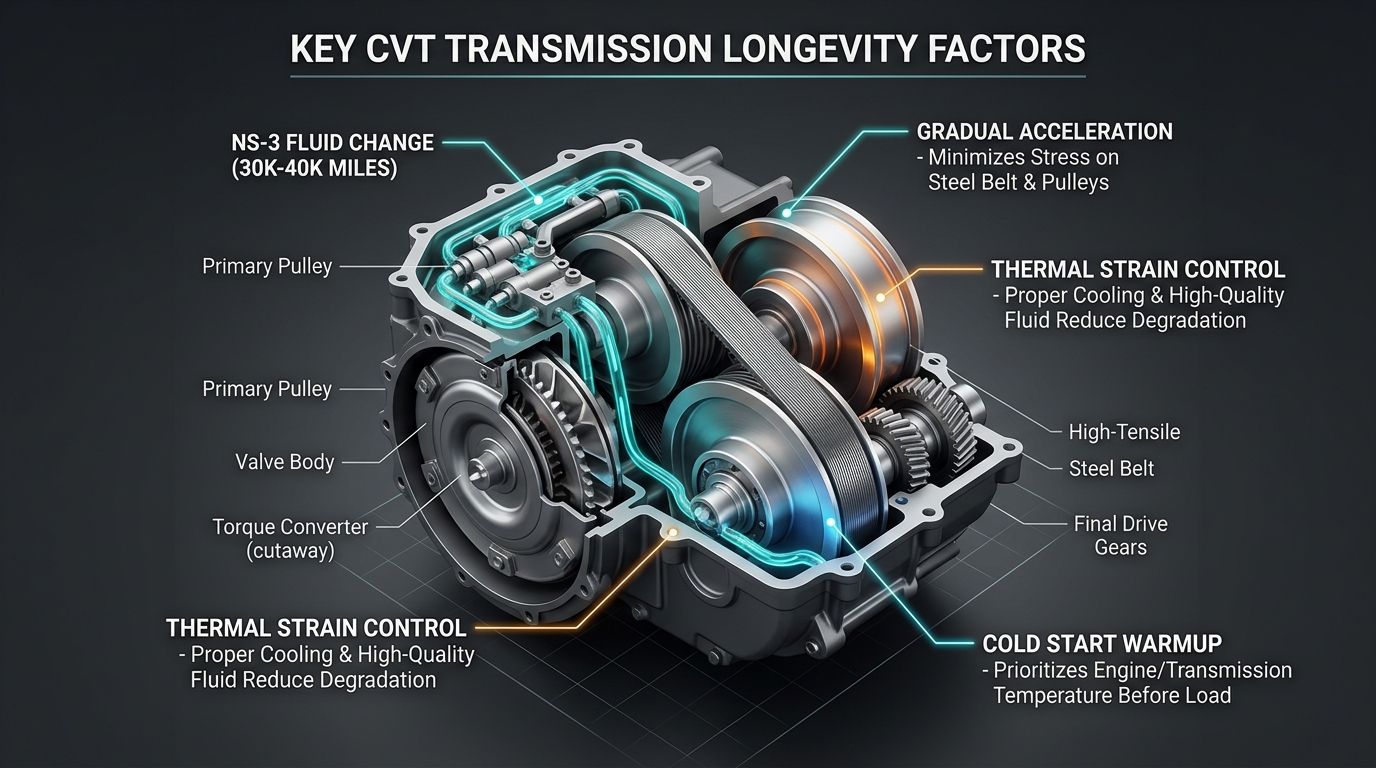
Extending the lifespan of a 2026 Nissan CVT requires adhering to severe-duty fluid service intervals every 30,000 to 40,000 miles using genuine NS-3 CVT fluid, practicing gradual acceleration from a stop, allowing proper engine warm-up during winter freezes, and addressing thermal strain early. Regular fluid inspections and gentle driving habits prevent premature pulley wear and maintain smooth hydraulic pressure.
Maintaining continuously variable transmissions depends heavily on fluid quality and thermal regulation. Unlike standard gearboxes that use fixed teeth, Nissan transmission designs rely on fluid friction to transfer power between high-tensile steel belts and smooth pulley faces. Over time, heat cycles break down the protective additives in the lubricant, reducing its ability to prevent metal-to-metal friction. For models like the 2026 Nissan Rogue, which features a 1.5L VC-Turbo engine, maintaining fresh fluid is vital to handling torque smoothly without strain.
Navigating daily stop-and-go traffic along Touhy Avenue in Niles places higher thermal demands on transmission fluid than steady highway cruising. Environmental factors like prolonged sub-freezing winter weather also cause fluid viscosity changes that require cautious driving during cold starts. Allowing the engine to idle briefly before driving gives the lubricant time to circulate through the hydraulic control valve body, ensuring proper belt clamping pressure.
Routine multi-point inspections help catch minor issues, such as weeping cooler line seals or microscopic metal debris in the oil pan, before they escalate into significant component wear. Drivers seeking professional routine upkeep can find our Niles service facility address or give our certified service desk a call at (224) 537-0287 for personalized maintenance recommendations.
Table of Contents
- How Does a Nissan Xtronic CVT Work and What Are Its Main Components?
- What Are the Signs of a Failing Nissan CVT Transmission?
- Should You Perform a Nissan CVT Fluid Flush or Drain-and-Fill?
- What Driving Habits and Special Tools Keep Your Nissan CVT Operating Efficiently?
- Common Questions About Nissan CVT Maintenance and Reliability
- What Should You Ask in a Local Nissan CVT Service Quote?
How Does a Nissan Xtronic CVT Work and What Are Its Main Components?
A Nissan Xtronic CVT utilizes a high-strength steel belt running between two variable-diameter hydraulic pulleys rather than traditional fixed planetary gears, maintaining the engine in its optimal powerband continuously. Key system components include the primary drive pulley, secondary driven pulley, hydraulic valve body, Transmission Control Module ( TCM), and an auxiliary fluid cooler.
The core advantage of this stepless design is seamless ratio adjustment. As the primary pulley narrows under hydraulic command from the TCM, the secondary pulley widens, changing the drive ratio smoothly without the step-shifts of conventional automatics. This continuous adaptation allows engines like the 2.5L 4-cylinder in the 2026 Nissan Altima to operate at peak efficiency, contributing to EPA ratings of up to 26 city / 36 highway MPG. CVTs generally improve fuel economy by 1 to 3 MPG compared to standard automatic transmissions by eliminating inefficient engine revving between gear changes.
To handle heavier crossover demands, systems like the Xtronic CVT paired with the 2.0L engine in the 2026 Nissan Murano incorporate advanced thermal management systems. The primary components that keep the drive system operating smoothly include:
- Primary and Secondary Pulleys: Hydraulically controlled sheaves that continuously adjust diameter to vary transmission ratios.
- Steel Drive Belt: A durable multi-link steel belt designed to withstand high friction and torque transfers across pulley faces.
- Hydraulic Valve Body: The central control manifold that routes fluid under precise pressure to adjust pulley widths.
- Transmission Control Module (TCM): The onboard computer that calculates optimal gear ratios based on throttle position, speed, and vehicle load.
- Fluid Cooler and Heat Exchanger: Components engineered to dissipate extreme thermal build-up generated during extended driving or towing up to the 1,500 lbs limit.
Understanding these mechanical linkages highlights why proper fluid conditioning is essential. You can explore our main dealership website to discover overall vehicle care solutions or check interactive direction details to visit our facility for a complete system inspection.
What Are the Signs of a Failing Nissan CVT Transmission?
The most reliable signs of a failing Nissan CVT include shuddering or jerking during acceleration, a noticeable delay or hesitation when engaging drive from park, high-pitched whining noises under load, engine revving without corresponding vehicle acceleration, and fluid leaks beneath the engine bay.
Recognizing these symptoms early prevents minor operational glitches from turning into complete mechanical breakdowns. Shuddering during acceleration often points to slipping between the steel belt and pulley faces or hydraulic pressure fluctuations within the valve body. Electrical communication delays between engine sensors and the TCM can also cause sudden surging or brief power loss during highway passing maneuvers.
Whining or high-pitched humming sounds typically indicate worn bearings, pump cavitations, or fluid that has broken down due to excessive heat. When transmission fluid overheats, safety protocols may trigger a protective fail-safe mode, restricting engine power to reduce internal heat generation. If you notice a sweet, burnt odor alongside dashboard warning lights, the fluid has exceeded its safe thermal threshold and lost its friction-modifying properties.
Suburban commuting along Oakton Street in Skokie during freezing winter months can make fluid degradation symptoms like cold-start hesitation stand out even more. When local drivers bring in a vehicle showing potential transmission wear, our technicians evaluate real-time diagnostic trouble codes to pinpoint valve body performance before major damage occurs. Owners interested in maintaining their vehicles can read verified owner feedback regarding our diagnostic care or available maintenance offers designed for routine care.
Should You Perform a Nissan CVT Fluid Flush or Drain-and-Fill?
Nissan factory guidelines specify performing a traditional transmission drain-and-fill service rather than a high-pressure machine flush, as excessive chemical or hydraulic pressure can dislodge metal filings and damage fine internal valve body passages. A standard drain-and-fill safely refreshes fluid lubricity while protecting delicate internal seals.
During a standard drain-and-fill, old fluid drains naturally from the pan, capturing suspended contaminants and metallic particles settling near the drain plug magnets. Technicians then remove the pan to clean the internal magnets, inspect for excessive metal debris, replace the fluid filter screen, and install a fresh pan gasket. Fresh, factory-specified NS-3 CVT fluid is added to restore proper anti-shudder friction characteristics.
Factory maintenance schedules generally recommend inspecting transmission fluid every 10,000 to 15,000 miles. Under normal driving conditions, complete fluid replacement is typically scheduled every 60,000 miles or 72 months. However, severe driving conditions require shortening this service window to 30,000 miles. Operating conditions that trigger severe-duty maintenance schedules include:
- Frequent short trips under 10 miles in severe winter cold
- Extensive idling or frequent stop-and-go city traffic
- Driving in dusty, unpaved, or heavily salted road environments
- Towing trailers, carrying heavy roof loads, or driving through mountainous terrain
Skipping required fluid changes in the 30,000 to 60,000-mile range causes fluid oxidation, leading to thermal breakdown and accelerated pulley wear. Drivers looking to compare long-term vehicle ownership pathways can review buying versus leasing considerations or check current service specials to stay on top of scheduled maintenance schedules and make informed decisions about their vehicle care.
What Driving Habits and Special Tools Keep Your Nissan CVT Operating Efficiently?
Maximizing Nissan CVT efficiency and longevity depends on smooth, progressive accelerator inputs, avoiding aggressive standing launches or heavy towing, alongside utilizing precise service tools such as an OBD2 scanner capable of reading real-time transmission fluid temperature, a fluid transfer pump, a level overflow adapter, and a torque wrench.
Driving habits directly influence the physical workload placed on the transmission belt. Hard acceleration from a complete stop generates peak torque loads across the steel belt and pulleys before hydraulic clamping pressure fully stabilizes. Easing onto the throttle allows pressure to build smoothly, minimizing mechanical stress. Furthermore, allowing the car to come to a complete stop before switching between Reverse and Drive prevents directional torque shocks that stress internal components.
For DIY enthusiasts or professional technicians, changing NS-3 CVT fluid requires specialized tools to ensure precise fluid level calibration. Because CVT fluid expands significantly as temperature rises, fluid levels cannot be judged by volume alone. Proper fluid adjustments require:
- An OBD2 diagnostic scanner capable of monitoring live TCM data and fluid temperature readings
- A fluid transfer pump to push fresh fluid into sealed transmission fill ports
- A dedicated level overflow adapter or dipstick gauge calibrated for specific casing depths
- A precision torque wrench to secure pan bolts to exact factory inch-pound specifications
Hardware and electronic software updates introduced across Nissan model lineups starting between 2018 and 2020 enhanced belt tension control and fluid thermal management. Maintaining updated control software through factory diagnostics ensures optimal pulley clamping. You can learn about our local community initiatives and our commitment to supporting regional drivers with complete vehicle care.
Common Questions About Nissan CVT Maintenance and Reliability
Q: Does extreme cold winter weather affect Nissan CVT fluid performance?
Sub-freezing winter temperatures significantly increase transmission fluid viscosity, causing temporary sluggishness or delayed engagement when starting cold. Allowing the engine to idle for a minute before driving lets the fluid warm up and circulate through the valve body, ensuring proper hydraulic pressure protection.
Q: Does fluid type really matter for a Nissan CVT transmission?
Using the precise manufacturer-specified NS-3 CVT fluid is essential for transmission health. Generic multi-vehicle transmission fluids lack the exact friction modifiers required for steel belt traction on smooth pulleys, which can lead to belt slippage, rapid internal wear, and potential warranty denial.
Q: What should you ask a local service department about CVT maintenance?
Ask whether the quoted service includes draining and refilling with genuine NS-3 CVT fluid, inspecting cooler lines, cleaning internal pan magnets, replacing filters, and running a complete TCM diagnostic scan to verify fluid temperature readings and clear trouble codes.
Q: How does severe driving condition criteria shorten CVT service intervals?
Driving habits involving stop-and-go city traffic, short winter trips under 10 miles, extensive idling, or heavy cargo hauling subject the transmission fluid to high thermal stress. These factors shorten the standard 60,000-mile fluid replacement interval down to 30,000 miles.
Q: What warranty coverage applies to Nissan CVT components?
Factory powertrain warranty coverage spans 5 years or 60,000 miles, protecting internal transmission components, the hydraulic valve body, and control modules against manufacturing defects when documented maintenance schedules are maintained.
To keep your vehicle performing reliably, you can schedule maintenance via our online service scheduling system, read our service department overview, or learn about our Backed by Berman commitments for comprehensive ownership support.
What Should You Ask in a Local Nissan CVT Service Quote?
A thorough quote for Nissan CVT maintenance should explicitly itemize genuine NS-3 CVT fluid, replacement pan gaskets and filters, fluid temperature level calibration, labor costs, and a full diagnostic computer scan of the Transmission Control Module. Ensuring every component is detailed upfront protects against unexpected fees and guarantees factory-spec care.
When reviewing a service estimate, confirm that the technician will perform a standard drain-and-fill rather than a high-pressure flush. Ensure the quote specifies genuine OEM fluids rather than universal fluids, as improper friction properties can cause belt slippage. Asking whether the shop cleans the oil pan magnets and replaces external fluid cooler filters guarantees a complete service rather than a partial top-off.
Clear service quotes reflect a commitment to transparent care and long-term vehicle reliability. If you are ready to consult with our certified technicians, stop by our physical location in Niles, call our advisors directly at (224) 537-0287, or consider reaching out to our service advisors online to book your appointment today.
© 2026 Star Nissan. All rights reserved.