
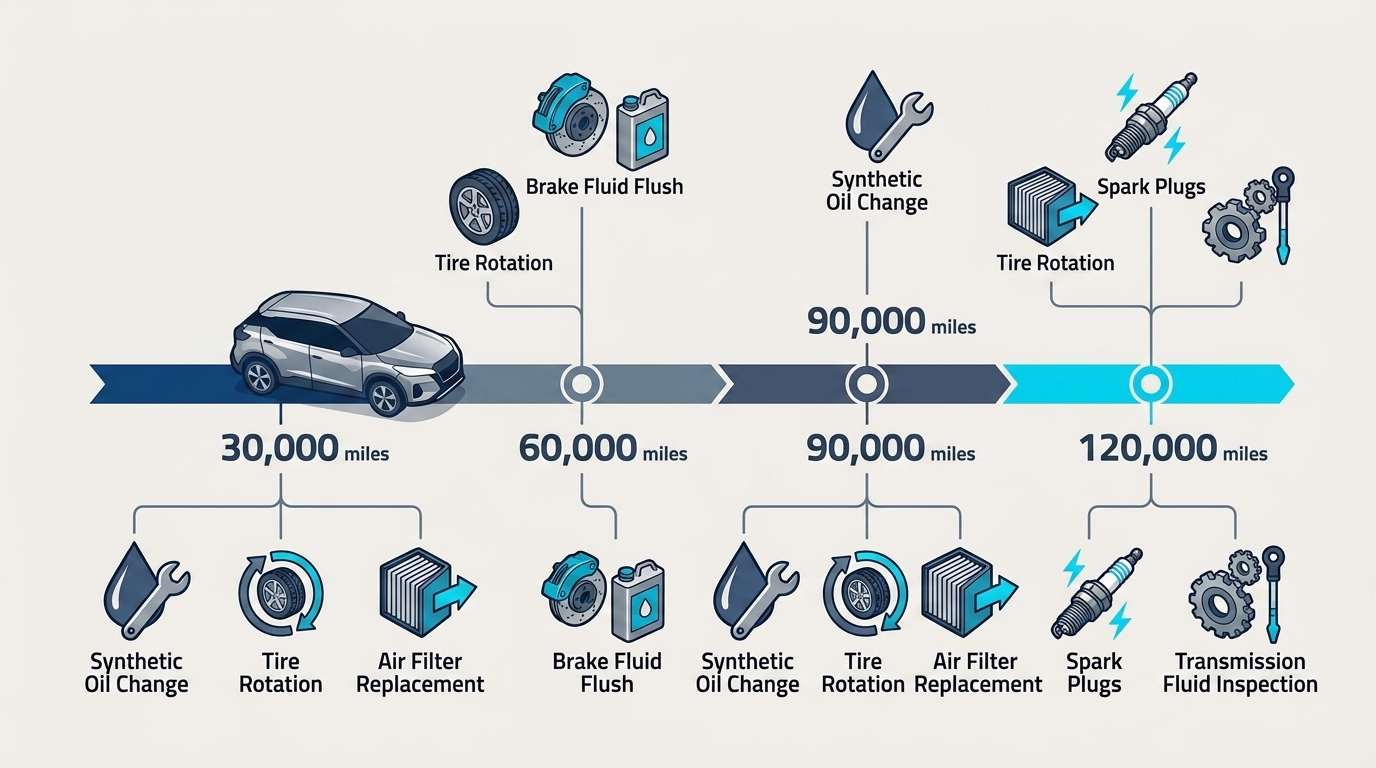
The official Nissan maintenance schedule follows routine minor service intervals every 5,000 to 7,500 miles for synthetic oil changes and tire rotations, paired with primary maintenance milestones at 30,000, 60,000, 90,000, and 120,000 miles. Key milestone services encompass engine and cabin air filter replacements, brake fluid flushes, spark plug replacements, and transmission fluid inspections to protect your vehicle's mechanical health and factory warranty.
Following a mileage-based schedule ensures that wearing components and operating fluids are serviced before thermal breakdown or mechanical friction causes unnecessary wear. Nissan categorizes maintenance into two distinct schedules based on driving habits: normal schedule and severe schedule. While the normal schedule assumes long stretches of steady highway driving in mild weather, everyday suburban driving patterns frequently fall into the severe category.
Severe driving conditions include frequent short trips under 10 miles, prolonged idling in heavy traffic, driving in sub-zero winter temperatures, and traveling on roads treated with heavy de-icing salt. For drivers along Touhy Avenue, winter weather extremes and stop-and-go commuting mean that inspection intervals for systems like the Xtronic CVT and brake hydraulics should be monitored closely. To review your specific model's maintenance schedule or consult with certified technicians, you can visit our service center in Niles or give our service department (224) 537-0287 for personalized guidance.
Table of Contents
- What services are included in Nissan's 30,000-mile maintenance schedule and is it considered major?
- What makes the 60k, 90k, and 120k mile Nissan service intervals different?
- How often should Nissan oil be changed between major service intervals and do schedules vary by model?
- Does getting your Nissan serviced at an independent shop void the factory warranty?
- Common Questions About Nissan Maintenance Schedules
- Schedule Your Nissan Mileage Maintenance Service in Niles Today
What services are included in Nissan's 30,000-mile maintenance schedule and is it considered major?
Nissan's 30,000-mile maintenance schedule is considered the first major service milestone, requiring engine air filter replacement, cabin microfilter renewal, a brake fluid exchange, an engine oil and filter change, tire rotation, and a comprehensive multi-point inspection. While it represents a major service checkpoint, it is the least intensive of the major milestone intervals.
At 30,000 miles, several key fluid and filtration systems reach their first engineered service limit. Replacing the engine air filter removes trapped road debris and dust, allowing clean airflow to the engine intake. This directly supports fuel economy in models like the 2026 Nissan Rogue equipped with a 1.5L VC-Turbo engine or the Nissan Altima powered by a 2.5L engine. Concurrently, replacing the cabin microfilter ensures that pollen, airborne dust, and seasonal allergens are filtered out before entering the HVAC system.
Brake fluid maintenance is another critical requirement at this 30,000-mile interval. Hydraulic brake fluid is naturally hygroscopic, meaning it absorbs moisture from ambient humidity over time. Accumulated water content lowers the boiling point of the fluid, which can result in a soft brake pedal feel and internal corrosion of hydraulic calipers and lines. Technicians flush out contaminated fluid and install fresh DOT 3 brake fluid to restore firm pedal feel and stopping responsiveness.
Beyond filters and fluids, the 30,000-mile visit includes a detailed multi-point safety inspection. Technicians check brake pad thickness, rotor surface wear, steering link boot seals, exhaust mounting hardware, drive shafts, and battery health. If your vehicle operates under severe driving conditions, technicians may also perform an initial inspection of the continuous variable transmission fluid. To maintain your vehicle's service timing conveniently, you can explore our express maintenance service options for quick turnaround times on routine care.
What makes the 60k, 90k, and 120k mile Nissan service intervals different?
The 60,000, 90,000, and 120,000-mile intervals build upon basic filter and oil changes by introducing specialized drivetrain, cooling, and ignition care tailored to aging mechanical components. The 60,000-mile mark focuses on transmission fluid renewal and primary ignition checks, the 90,000-mile service prioritizes long-life spark plug replacements and belt inspections, and the 120,000-mile milestone delivers a complete cooling system flush alongside comprehensive mechanical component care.
Each subsequent 30,000-mile checkpoint targets specific wear items that require attention further into the vehicle's lifespan:
- 60,000-Mile Milestone: Servicing the Xtronic CVT fluid becomes a central focus at 60,000 miles. Over tens of thousands of miles, transmission fluid experiences intense mechanical shear and thermal stress, gradually losing its protective viscosity. Fresh fluid protects internal steel belts and pulleys from premature friction wear. This interval also repeats engine and cabin air filter replacements, brake fluid renewal, tire rotation, and thorough suspension component checks.
- 90,000-Mile Milestone: The 90,000-mile service centers on ignition and drive belt health. Modern Nissan engines utilize iridium spark plugs engineered for extended durability, but by 90,000 miles, electrodes gradually erode, increasing the spark gap. Replacing worn plugs prevents cylinder misfires, rough idling, and loss of acceleration performance. Technicians also perform a detailed examination of serpentine drive belts, checking for rubber cracking or tension loss.
- 120,000-Mile Milestone: As a comprehensive high-mileage overhaul, the 120,000-mile interval includes an engine coolant flush. Over time, anti-corrosion additives in engine coolant deplete, allowing rust and scale to build up inside the radiator and heater core. Replacing the coolant protects internal engine passages and water pump seals. For all-wheel-drive models like the 2026 Nissan Pathfinder featuring a 3.5L V6 engine, this service also addresses transfer case and rear differential fluid exchanges.
Commuters navigating daily traffic patterns near Skokie experience elevated brake and transmission wear due to constant stopping and starting. Staying diligent with these major milestones prevents minor component degradation from turning into larger mechanical issues.
How often should Nissan oil be changed between major service intervals and do schedules vary by model?
Nissan vehicles require engine oil and filter changes every 5,000 to 7,500 miles or every six months, whichever comes first, when using recommended full-synthetic oil. Service intervals vary slightly based on powertrain design, turbocharging requirements, and severe driving conditions.
Maintaining clean motor oil between major milestone visits is fundamental to engine longevity. Modern Nissan engines depend on advanced synthetic oils, such as 0W-20 or 0W-16 formulations, to lubricate tight internal engine tolerances, reduce friction, and dissipate heat. Over time, heat breaks down chemical oil viscosity while combustion byproducts create carbon sludge. Regular oil changes ensure internal components remain clean and fully lubricated.
Specific engine designs require tailored attention during routine oil care:
- Variable Compression Turbo Engines: Powertrains like the 1.5L VC-Turbo in the Nissan Rogue alter their compression ratio dynamically to balance power and efficiency. Because turbocharged engines operate under elevated thermal conditions, adhering strictly to a 5,000 to 7,500-mile synthetic oil schedule is essential to protect turbocharger shaft bearings.
- Naturally Aspirated Four-Cylinders: Engines such as the 2.5L 4-cylinder in the Nissan Altima follow standard 7,500-mile intervals under normal highway conditions. However, under severe short-trip driving, shortening the interval to 5,000 miles prevents moisture build-up in the crankcase.
- V6 Powertrains & Towing Vehicles: The 3.5L V6 engine in the Nissan Pathfinder provides up to 6,000 lbs of maximum towing capacity when properly equipped. Heavy trailering increases engine oil and transmission fluid temperatures, making 5,000-mile oil maintenance intervals highly recommended for active tow ers.
Drivers who bring their Rogue or Altima in for regular oil changes often ask if they can stretch intervals on highway-only trips; time and winter temperature swings degrade oil additives just as fast as mileage, making the six-month time boundary just as important as the odometer reading.
Does getting your Nissan serviced at an independent shop void the factory warranty?
Servicing your Nissan at an independent repair shop does not void your factory warranty, as federal protection under the Magnuson-Moss Warranty Act permits owners to have routine maintenance performed at any qualified facility without invalidating coverage. However, you must retain itemized receipts and proof of service, and any repair failure directly caused by improper parts or workmanship from an independent shop will not be covered under warranty.
To maintain your warranty protection when using an independent shop, you must keep organized records containing the date of service, exact mileage, vehicle identification number, and detailed lists of parts and fluid specifications used. If an engine or transmission component experiences a warrantable failure in the future, the manufacturer may request maintenance documentation to verify that the failure was not caused by skipped service or improper fluid specifications.
While independent repair facilities can handle standard oil changes, bringing your vehicle to an authorized dealership offers several distinct advantages for long-term ownership care:
- Factory-Trained Technicians: Dealership technicians undergo continuous brand-specific training, mastering precise mechanical clearances, diagnostic software, and repair procedures specific to Nissan vehicles.
- Genuine OEM Parts & Approved Fluids: Dealerships exclusively install genuine OEM filters and factory-formulated fluids, such as genuine Nissan NS-3 fluid for continuous variable transmissions, preventing damage from incompatible generic fluids.
- Integrated Warranty & Campaign Support: Authorized service departments automatically scan for active service campaigns, software updates, and recall notices during routine visits, completing eligible repairs under factory coverage at no cost to you.
- Streamlined Claims: Should a component fail within your 5-year/60,000-mile powertrain warranty window, service records logged directly in the factory database eliminate the need to manually gather paper receipts.
Common Questions About Nissan Maintenance Schedules
Q: What happens if I miss a scheduled maintenance milestone on my Nissan?
Delaying routine service allows engine oil contaminants to accumulate, filter airflow to restrict, and fluids to degrade, increasing component friction and wear. Missing milestone services can also complicate future warranty claims if a mechanical failure occurs in an unserviced component. Bringing your vehicle in as soon as possible allows technicians to perform catching-up maintenance and verify systems health. You can learn more about our comprehensive customer care promise to see how routine maintenance support keeps your vehicle operating smoothly.
Q: Is brake fluid replacement always required at 30,000 miles?
Nissan may recommend replacing brake fluid every 30,000 miles or two years, depending on model and driving conditions because brake fluid is hygroscopic and naturally absorbs moisture from the air over time. Accumulated moisture lowers the boiling point of the fluid, causing soft pedal feel and accelerating internal corrosion in calipers and master cylinders. Replacing fluid maintains firm pedal response and protects hydraulic components.
Q: How do I know if my driving qualifies as "severe" maintenance?
Your driving qualifies as severe if you make frequent short trips under 10 miles, drive extensively in stop-and-go traffic, tow heavy loads, or commute in extreme summer heat or freezing winter salt conditions. Most daily commuters in the northern Chicago suburbs fit severe driving parameters, meaning fluids and filters benefit from being serviced closer to lower mileage thresholds.
Q: What is included in a Nissan multi-point inspection?
A factory multi-point inspection evaluates critical safety and mechanical components, including brake pad thickness, rotor condition, tire tread depth, battery health, suspension bushings, drive belts, fluid levels, and exhaust integrity. Technicians use a color-coded reporting system—green for healthy, yellow for future attention, red for immediate care—so you have complete visibility into your vehicle's condition. Read more about our dealership history and staff to discover our commitment to clear, technical service communication.
Q: How does dealership service protect my vehicle's resale value?
Maintaining your vehicle at an authorized service center builds a verified, centralized digital service history that prospective buyers and valuation tools recognize. Complete maintenance records demonstrating factory-recommended care with genuine OEM parts validate that the vehicle was well-maintained, yielding higher trade-in and resale values.
Schedule Your Nissan Mileage Maintenance Service in Niles Today
Keeping up with your Nissan vehicle's 30k, 60k, 90k, and 120k maintenance schedule is the single best way to ensure reliable daily performance, maximum fuel economy, and long-term mechanical health. Whether you drive a Rogue, Altima, or Pathfinder, our factory-certified technicians are equipped with advanced diagnostic tools and genuine OEM parts to complete every milestone service accurately.
To reserve your upcoming maintenance appointment or consult with our service advisors regarding your vehicle's specific maintenance history, visit our service department at 5757 W Touhy Ave or contact our team directly at (224) 537-0287. We look forward to helping you protect your automotive investment for years to come.
© 2026 Star Nissan. All rights reserved.