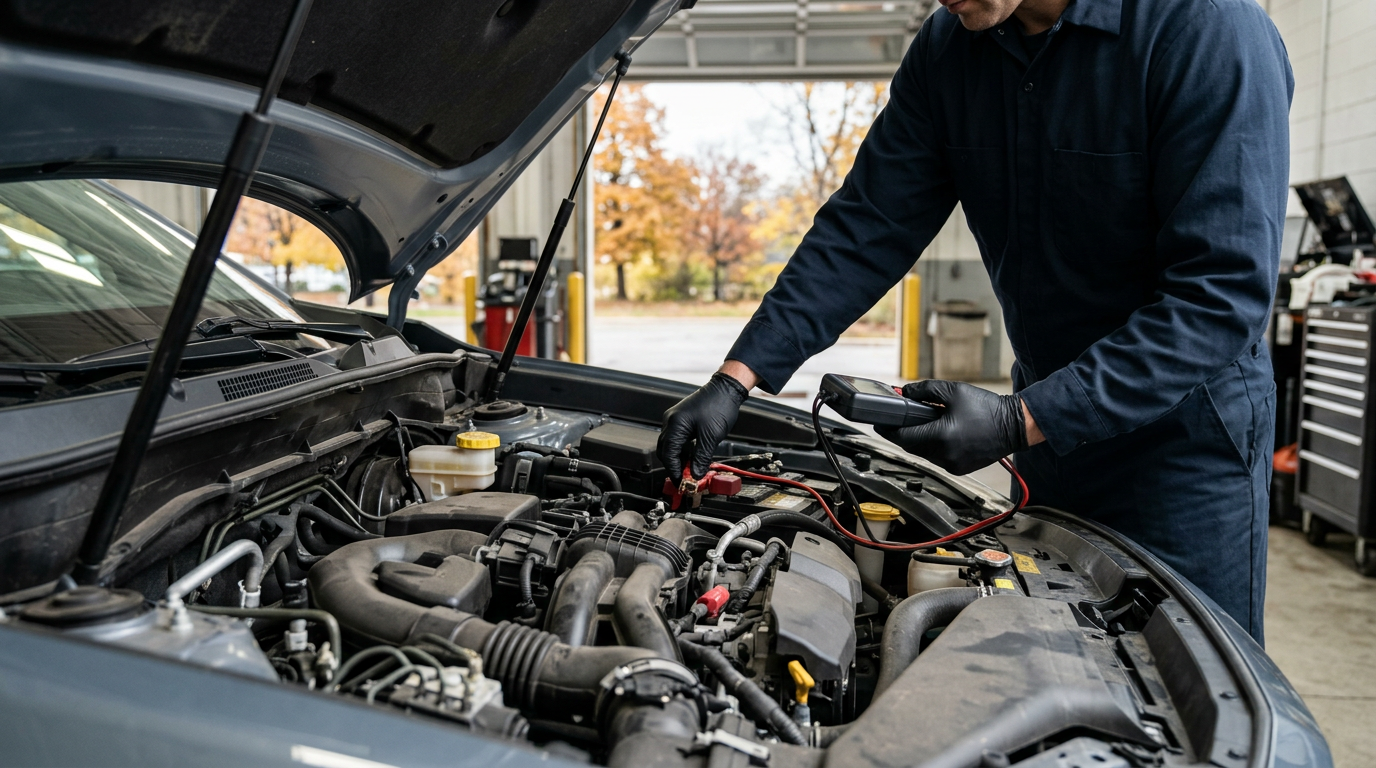
 Preparing a car for a Chicago winter requires completing five core maintenance tasks before the first hard freeze: load-testing the 12-volt battery, maintaining at least 5/32 of an inch of tire tread depth, setting proper cold tire inflation pressures, filling freeze-resistant windshield washer fluid, and inspecting brake components and engine coolant. Completing these essential checks by late October helps promote reliable starting power and better control on snow-covered roads.
FALL VEHICLE WINTERIZATION CHECKLIST
| [ System ] | [ Key Inspection Point ] |
|---|---|
| 1. Battery | Load test; verify clean terminals |
| 2. Tires | Ensure 5/32" tread depth; adjust cold PSI |
| 3. Motor Oil | Switch to synthetic 0W-20 or 5W-30 |
| 4. Fluids | Verify 50/50 coolant mix; de-icing fluid |
| 5. Brakes & Wipers | Measure pad thickness; swap winter blades |
Late autumn in northern Illinois brings rapid temperature drops that test every major mechanical system in your vehicle. When temperatures drop below freezing, internal engine friction increases, engine oil thickens, and battery output drops significantly. Performing a systematic fall inspection can help reduce the risk of unexpected roadside breakdowns during severe weather events.
The seasonal transition from warm weather to sustained sub-freezing temperatures requires a focused maintenance approach. For suburban drivers navigating flat terrain and commercial corridors near Niles, winterizing early prevents sudden non-start conditions during freezing rain or snowfall. Vehicle components like belts, hoses, and electrical connections contract in severe cold, making existing minor wear far more likely to turn into complete system failures.
A complete fall maintenance plan addresses both mechanical readiness and driving safety. Systematically evaluating electrical output, fluid freeze points, braking efficiency, and tire friction gives your vehicle the structural support required for harsh winter driving. Drivers can visit our service center location at 5757 W Touhy Ave, Niles, IL 60714 or call (224) 537-0287 to consult with our certified service advisors about customized seasonal prep.
Table of Contents
- What Tire Tread Depth and Pressure Are Needed for Snow and Ice in Chicagoland?
- How Do Cold Weather, Motor Oil Viscosity, and Battery Life Affect Midwest Winter Starts?
- Which Vital Fluids, Wiper Blades, and Brakes Should Be Checked Before the First Freeze?
- What Items Belong in a Winter Emergency Kit and How Much Does an Inspection Cost?
- Key Fall Vehicle Maintenance Questions Before a Chicago Winter
- Schedule Your Fall Winterization Service at Star Nissan
What Tire Tread Depth and Pressure Are Needed for Snow and Ice in Chicagoland?
Safe driving on snow and ice requires a minimum tire tread depth of 5/32 to 6/32 of an inch and routine inflation checks to account for cold weather pressure drops. While Illinois law permits a minimum tread depth of 2/32 of an inch, that baseline depth is designed solely to prevent hydroplaning on rain and is less effective at channeling packed snow or biting into ice.
TIRE TREAD DEPTH TRACTION THRESHOLDS
| Tread Depth | Condition Evaluation |
|---|---|
| 2/32" | Illinois Legal Limit; Unsafe for Winter Driving |
| 4/32" | Adequate for Rain; Reduced Traction on Snow |
| 5/32" - 6/32" | Recommended Minimum for Deep Snow & Ice Traction |
Tire tread channels slush away from the contact patch to maintain direct contact with the road surface. When tread depth falls below 5/32 of an inch, snow becomes trapped within the sipes, creating a slick surface that drastically increases stopping distances. Suburban commuters driving near Skokie during early morning frosts often experience sudden low tire pressure warnings as overnight ambient temperatures plummet.
Ambient temperature changes directly alter tire pressure. For every 10°F drop in outdoor temperature, tire pressure decreases by approximately 1 to 2 psi. A vehicle set to 33 psi during a warm 65°F October afternoon can easily drop below 27 psi during a 25°F November cold spell, triggering the tire pressure monitoring system (TPMS) light and compromising shoulder tread wear.
Proper tire care involves the following best practices:
- Measure tread depth across inner, center, and outer grooves using a dedicated gauge.
- Check cold inflation pressure first thing in the morning before driving.
- Set pressures to the recommended numbers printed on the driver’s door pillar placard.
- Inspect sidewalls for bulges, cracking, or uneven wear caused by summer potholes.
Advanced traction systems like Intelligent AWD on models like the 2026 Nissan Rogue or 2026 Nissan Pathfinder rely heavily on tire grip. While all-wheel drive manages engine torque distribution to prevent wheel spin, stopping performance depends entirely on tire compound flexibility and tread depth. Drivers can streamline their seasonal prep by scheduling express service online and reading our customer reviews to learn how our technicians evaluate winter tire condition.
How Do Cold Weather, Motor Oil Viscosity, and Battery Life Affect Midwest Winter Starts?
Car batteries in the Midwest typically last between 3 and 5 years due to severe seasonal temperature shifts between hot summers and freezing winters. Pairing a pre-winter battery load test with low winter-viscosity synthetic motor oil, such as 0W-20 or 5W-30, can help promote quicker cranking speeds and faster oil circulation during sub-zero cold starts.
BATTERY CAPACITY VS. ENGINE STARTING LOAD
| Ambient Temp | Battery Power Available | Engine Cranking Effort |
|---|---|---|
| 80°F | 100% Full Capacity | Baseline (100%) |
| 32°F | ~80% Capacity | Moderate Increase (~130%) |
| 0°F | ~50% Capacity | High Increase (~210%) |
Summer heat accelerates internal plate corrosion and electrolyte evaporation inside a 12-volt battery. When freezing temperatures arrive in late fall, the chemical reactions that generate electrical current slow down dramatically. At 0°F, a battery retains roughly half of its normal cranking power while the cold engine demands significantly more energy to turn over.
Motor oil viscosity plays an equally critical role in cold-weather engine survival. Standard conventional oils thicken in sub-freezing temperatures, resisting movement through narrow engine passages during initial startup. Utilizing a manufacturer-recommended low-viscosity synthetic oil like 0W-20 or 5W-30 allows the oil pump to pressurize the system almost instantly, preventing metal-on-metal contact during cold starts.
Our service team frequently observes that batteries passing visual checks still fail digital load tests in October. Testing cold-cranking amps (CCA) and reserve capacity before winter identifies weak cells before they leave you stranded. Replacing an aging battery at the 3-to-5-year mark prevents unexpected starting failures on frozen mornings.
Which Vital Fluids, Wiper Blades, and Brakes Should Be Checked Before the First Freeze?
Winterizing vital fluids, replacing wiper blades, and measuring brake pad thickness before the first hard freeze protects mechanical components from freezing damage and salt corrosion. Using washer fluid formulated to resist freezing ensures clear vision through road salt spray.
Engine coolant does far more than regulate summer engine temperatures; it provides essential freeze and corrosion protection. Standard engine coolant must maintain a proper 50/50 mixture of antifreeze and distilled water to prevent fluid from freezing solid inside the radiator and engine block. Water expands as it freezes, which can split radiator headers, burst heater cores, and crack engine blocks.
Visually checking windshield wiper blades and fluid reservoirs prevents dangerous blindness during winter storms. Essential winter vision steps include:
- Refilling the washer reservoir with de-icing fluid rated to -20°F or lower.
- Replacing streaking or torn rubber wiper blades with heavy-duty winter blades.
- Cleaning the windshield glass thoroughly inside and out to eliminate night glare.
- Verifying proper operation of front and rear windshield defrosters.
Brake systems face harsh operating conditions during Midwest winters. Road salt, moisture, and sand cause rapid oxidation on unprotected brake rotors and slide pins. Inspecting pad thickness, rotor surfaces, and caliper movement before winter ensures balanced braking force on slippery surfaces.
What Items Belong in a Winter Emergency Kit and How Much Does an Inspection Cost?
A comprehensive winter emergency kit should contain safety gear designed to keep occupants warm, visible, and mobile during unexpected road delays or severe storms. A professional multi-point pre-winter inspection generally costs between $50 and $150, making it an affordable way to verify winter vehicle readiness.
Building a dedicated winter emergency kit ensures you are prepared for unexpected winter weather challenges. Store these vital supplies in your trunk or cargo area:
- Heavy-duty ice scraper and telescoping snow brush.
- Commercial jumper cables or a portable lithium jump-pack.
- Compact folding shovel and a bag of sand or cat litter for tire traction.
- LED flashlight with extra batteries or a rechargeable work light.
- Thermal Mylar blanket, fleece blanket, and insulated work gloves.
- Portable mobile phone power bank and charging cables.
- Non-perishable energy bars and bottled water.
A pre-winter multi-point inspection provides a thorough evaluation of critical vehicle systems. Technicians measure brake pad lining, perform battery conductance tests, check fluid hydrometer levels, analyze tire tread depth, and inspect drive belts and cooling system hoses.
If severe weather causes a roadside emergency, official Nissan Roadside Assistance at (800) 225-2476 provides 24/7 towing, battery jump-starts, flat tire support, and lockout assistance backed by certified technicians and factory standards.
Key Fall Vehicle Maintenance Questions Before a Chicago Winter
Q: How early in the fall should winter vehicle prep be completed?
Completing winter vehicle prep by late October or early November helps prepare your car before freezing temperatures and severe snowfall arrive. Scheduling service early avoids long wait times during the initial autumn rush.
Q: Can all-season tires handle a typical Chicago winter or are winter tires necessary?
All-season tires with at least 5/32 of an inch of tread depth can manage moderate snow, but dedicated winter tires offer far superior rubber flexibility below 45°F. Winter tires shorten stopping distances significantly on packed snow and glare ice.
Q: Why does my tire pressure warning light turn on during cold autumn mornings?
Tire pressure decreases by 1 to 2 psi for every 10°F drop in outside temperature. Overnight temperature drops cause internal tire pressure to fall below the TPMS threshold, triggering the dashboard warning light until pressures are adjusted.
Q: What should I do if my battery is more than three years old before winter?
Have the battery load-tested by a certified technician during your fall maintenance appointment. Midwest seasonal temperature swings wear down batteries quickly, and replacing a weak 12-volt battery prevents sudden non-start issues.
Q: Does road salt cause undercarriage damage during Midwest winters?
Road salt reacts with moisture and oxygen to accelerate rust formation on exposed metal undercarriage parts, exhaust systems, and brake lines. Washing the underbody regularly throughout the winter removes salt accumulation and prevents corrosion.
Drivers interested in comprehensive ownership benefits can explore our Backed By Berman program information and learn more about our dealership history and values.
Schedule Your Fall Winterization Service at Star Nissan
Preparing your car for severe cold, heavy snow, and icy road conditions requires thorough maintenance before freezing temperatures settle in. Checking your 12-volt battery, tire tread depth, wiper blades, and vital fluid freeze protection ensures your vehicle operates reliably all winter long.
Our factory-trained technicians use genuine OEM parts and specialized diagnostic equipment to perform comprehensive seasonal inspections. Connect with our service department at 5757 W Touhy Ave, Niles, IL 60714 or call (224) 537-0287 to schedule your fall maintenance appointment today.